UNASKED QUESTIONS. UNMASK GROWTH

Your business needs an insights layer to tell you what matters

You can have the entire modern data stack in place—warehouse, lineage, metrics, semantic layer, BI, even an AI interface—and discovery still waits for a human to ask the right question. Allyvate’s agents generate hypotheses, verify them against your governed definitions, and surface only what survives.

Read-onlyNo migration requiredGovernance keptRLS/CLS checked firstFully auditableEvidence on every finding
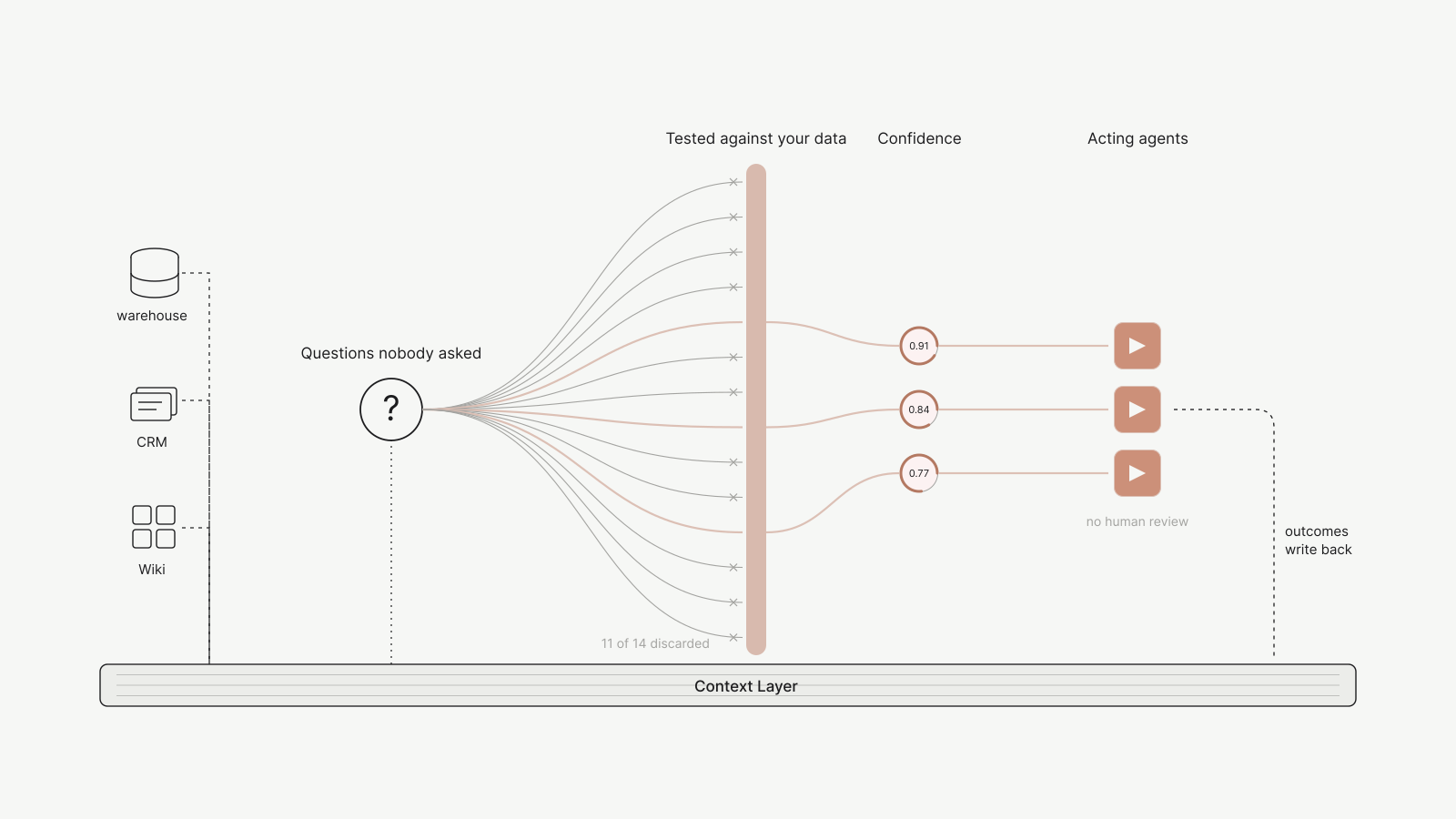
The question layer: agents generating and verifying hypotheses against the governed context layer
THE GAP YOU OWN

The semantic layer removes query friction. It does not remove the investigation loop

Even with a certified metric catalog, someone still decides what to ask, formulates the analysis, runs it, validates it and iterates. That loop is bounded by analyst attention, not by your platform.

HUMAN LOOP

Thirteen steps, on request

  1. Frame the problem into metrics, cohorts, windows
  2. Resolve every term in the metric catalog
  3. Validate grain, filters, coverage
  4. Check entitlements and classification
  5. Query through the semantic layer
  6. Sanity-check against certified totals
  7. Slice, drill, hypothesise, iterate
  8. Attach confidence, caveats, freshness by hand

Cadence: a handful of serious hypotheses a week.

ALLYVATE PIPELINE

Same steps, run continuously

  1. Intake Agent decomposes the objective into a question tree
  2. Terms resolved against the context graph; undefined terms flagged, not guessed
  3. Hypothesis Generator produces candidates breadth-first
  4. Access & Compliance Gate checks RLS/CLS before any query
  5. Verification Agent tests via the semantic query API
  6. Reconciliation cross-checks a certified number and lineage freshness
  7. Confidence Scorer ranks survivors; failures discarded
  8. Router delivers structured payloads with what would falsify them

Cadence: on schedule and on data-change triggers. The business reviews survivors.

WHERE THE QUESTION LAYER SITS

Your stack holds the data. This layer asks the questions

  1. 05Feedback layerMeasures outcomes, improves generation
  2. 04Action layerConnects findings to workflows
  3. 03The question layerDiscovers what matters, explains why
  4. 02Semantic & context layerDefines what the data means
  5. 01Data layerCollects, integrates, stores signals

The semantic layer establishes meaning. It tells a system that revenue, customer, order and retention are business concepts with defined relationships. The Insights Layer answers a different question:

Knowing what the data means, what is actually worth noticing?
  1. 01Bring or build the context layer. Read-only connection to dbt, LookML, Cube or Power BI datasets, plus catalog and lineage. Governed metrics are never redefined.
  2. 02If none exists, connectors profile schemas, definitions are drafted, and a human owner signs off before anything is governed.
  3. 03Either way you end with one context graph: metrics, entities, lineage, caveats, past questions and decisions taken.
THE AGENT PIPELINE

Every insight arrives verified, with its evidence attached

Agents draft hypotheses from your context graph, then test each one against governed definitions, entitlements and certified numbers. What reaches you carries the test it passed, the data behind it, and what would falsify it.

  1. 01

    Intake Agent

    Decomposes a business problem or scheduled objective into a question tree: metric, grain, dimensions, window, baseline, and the decision it feeds.

  2. 02 · THE QUESTION LAYER

    Hypothesis Generator

    Produces candidates from the question tree, context graph and statistical scans — anomalies, drift, segment divergence, cohort breaks. Includes questions the business didn't ask.

  3. 03

    Access & Compliance Gate

    Each hypothesis is mapped to required datasets and checked against RLS/CLS and classification tags before any query runs. Blocked hypotheses are logged, not silently dropped.

  4. 04

    Verification Agent

    Tests through the semantic layer's query API, falling back to warehouse SQL only when no metric exists — and logging the gap as backlog. Checks nulls, grain, timezone, currency, duplicates.

  5. 05

    Reconciliation

    Totals cross-checked against a certified dashboard or finance number; freshness verified from lineage. A mismatch marks a hypothesis unverifiable, not false.

  6. 06

    Confidence Scorer

    Scores survivors on statistical strength, freshness, sample size, certification level, reconciliation pass and novelty. Threshold configurable per business domain.

  7. 07

    Router to acting agents

    Survivors go to pricing, campaign, sales-ops or supply agents as structured payloads: hypothesis, evidence, confidence, affected segment, recommended action, what would falsify it.

  8. 08

    Feedback & Memory Writer

    Registers new metrics, attaches caveats to datasets, logs question → answer → action → outcome, and recalibrates the scorer on every run.

THE CASE FOR A LAYER

Insight should live in your architecture, not in a prompt

Provenance on every finding

Definition source, lineage, the test used and the confidence score travel with the insight. Findings retain the cohort, comparison window and metric behind them, so the reasoning is inspectable.

A confident wrong answer never ships

When agents act on their own output, a plausible error becomes an automated decision. Verification sits between generation and delivery: what fails is discarded before it reaches a person or an acting agent.

No migration, no rip-and-replace

Allyvate does not replace the warehouse, lakehouse, catalog, metrics layer, BI platform or semantic layer. It consumes governed data and context from what you already operate.

Insight that survives your model roadmap

Models change, agents change, interfaces change. Accumulated intelligence about what matters to the business should not be rebuilt each time — so it lives in an architectural layer, not in a prompt.

Semantic-layer debt made visible

Every fallback to raw SQL is logged as a gap, and undefined terms are flagged to their owner. Runs produce a backlog of the definitions your context layer is still missing.

Analyst capacity, redirected

Continuous hypothesis generation covers ground no team can cover on request. Analysts move from servicing the queue to judging survivors and acting on them.

THE QUESTIONS THAT COME UP IN TECHNICAL REVIEW

What this is, and what it isn’t

Does this replace our warehouse, semantic layer or BI?

No. A semantic layer defines what enterprise data means; Allyvate uses that context to investigate what matters. It sits above the data and semantic layers and works with the architecture you already have.

Is this anomaly detection with an LLM on top?

No. Detecting an anomaly is only one possible starting point. Allyvate investigates whether a change matters, what may explain it, what evidence supports the explanation, and what should be watched next. The most valuable finding is usually a business relationship, not a spike.

Does it require a specific model or agent framework?

No. Allyvate is model-agnostic by design. Insight generation is treated as an enterprise architectural capability rather than something embedded inside a particular LLM, prompt or agent framework.

How are entitlements and data classification handled?

Every hypothesis is mapped to the datasets it needs and checked against row- and column-level security and classification tags before any query runs. Blocked hypotheses are logged rather than silently dropped, so the gate is visible in the audit trail.

What happens when a result doesn't reconcile?

Totals are cross-checked against a certified dashboard or finance number and freshness is verified from lineage. A mismatch marks the hypothesis unverifiable rather than false, and it does not reach a decision-maker.

What if we don't have a governed semantic layer yet?

Connectors profile your schemas and draft metric and entity definitions, which a human owner signs off before they become governed. Lineage and freshness are tracked from job runs. Either path ends in one context graph.

RUN IT AGAINST YOUR DATA

Bring one messy domain. We’ll run a discovery pass on it

A working session with your data and platform team: connect read-only, build context, run the first pass. You review only what survives validation, with the evidence attached.

WHAT THE SESSION COVERS
  1. 01Where Allyvate reads from in your current stack
  2. 02How definitions, entitlements and lineage are respected
  3. 03A live run: hypotheses generated, gated, verified, ranked
  4. 04The semantic-layer gaps the run exposes