
AI Doesn’t Just Need Context. It Needs Curiosity.
A semantic layer reduces data discovery and query friction. It does not eliminate the human investigation loop. Here is that loop as an analyst actually runs it — and the same ten steps run end to end by agents.
At a glance
Even with a strong semantic/context layer, the analyst still has to decide what to ask, formulate the analysis, run it, validate it, and iterate. The semantic layer reduces data discovery and query friction; it doesn’t eliminate the human investigation loop. Allyvate runs that loop as a pipeline of agents: breadth-first hypothesis generation, verification as the filter, and only survivors routed to acting agents.
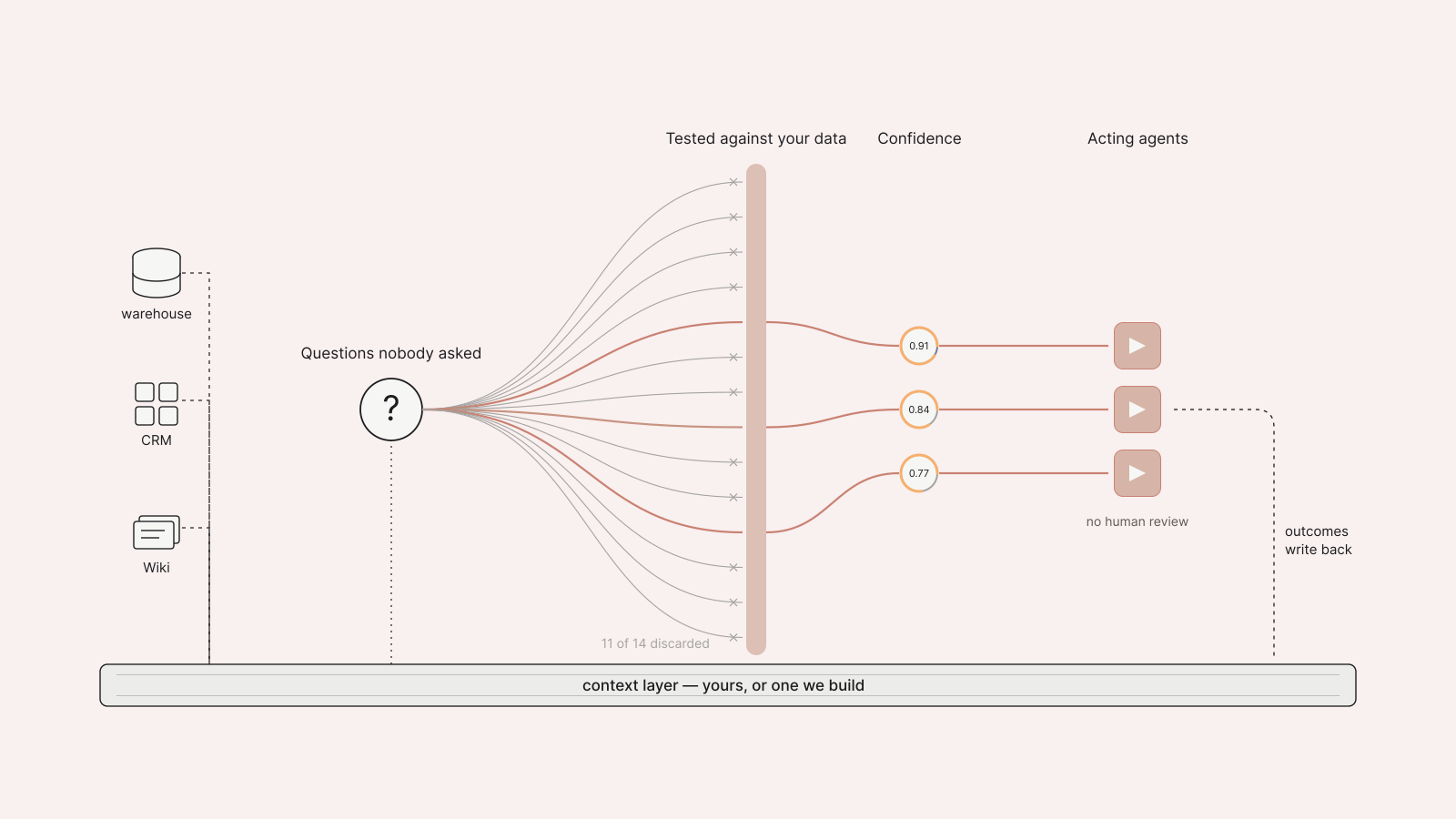
A human analyst has to walk a long series of steps to reach an insight: frame the ask, resolve definitions, get access, query, validate, investigate, iterate. Below, that workflow step by step — and how an agentic insights layer works.
Human analyst vs Allyvate agents, step for step
| Step | Human analyst | Allyvate agents |
|---|---|---|
| Framing | Frame the problem: translate the business ask into metrics, dimensions, cohorts, time windows. | Intake Agent decomposes the problem — or a scheduled objective — into a question tree and resolves every term against the context graph. |
| Definitions | Find the layer, resolve terms in the metric catalog, validate grain, filters and coverage. Never redefine locally. | Same governed definitions, read from the context graph. Undefined terms are flagged to the owner instead of guessed. |
| Access | Check row/column-level entitlements and classification before touching data; request grants via the governed path. | Access & Compliance Gate checks every hypothesis against RLS/CLS before any query runs. Blocked hypotheses are logged, not silently dropped. |
| Hypotheses | Investigate: slice, drill down, form hypotheses one at a time and iterate until the pattern is explainable. | Hypothesis Generator — the question layer — produces N candidates breadth-first from the question tree, context graph and statistical scans. Includes questions the business didn’t ask. |
| Querying | Query through the semantic layer, locate source data, write SQL with the right joins, windows and cohort logic. | Verification Agent tests every hypothesis via the semantic layer’s query API, dropping to warehouse SQL only when no metric exists — and logging the gap. |
| Validation | Sanity-check against known totals, historical trends, edge cases and reconciliation sources. | Reconciliation cross-checks totals against a certified number and verifies freshness from lineage. Mismatch marks a hypothesis unverifiable, not false. |
| Confidence | Surface confidence and caveats by hand: definition source, freshness, sample sizes, known gaps, what would change the conclusion. | Confidence Scorer scores each survivor on statistical strength, freshness, sample size, certification level, reconciliation and novelty. Failures discarded; threshold configurable per domain. |
| Delivery | Present evidence with methodology, assumptions, supporting data and limitations — to a human, who decides. | Router sends survivors straight to acting agents as structured payloads, including what would falsify them. No human in the loop by default; humans get a digest. |
| Memory | Feed back into the layers so the next analyst starts from step 3, not step 1 — if there is time. | Feedback & Memory Writer logs question → answer → action → outcome, registers new metrics and recalibrates the scorer on every run. |
| Cadence | On request. A handful of serious hypotheses a week, bounded by analyst attention. | Continuous mode: steps 2–8 run on schedule and on data-change triggers. The business stops asking questions; it reviews survivors. |
Analyst workflow in an enterprise with a semantic + context layer
- Frame the problem — Translate the business ask into measurable metrics, dimensions, cohorts, and time windows.
- Find the semantic/context layer — Identify relevant entities, metrics, relationships, business definitions, and available data sources.
- Resolve terms against the semantic layer — Look up each business term (e.g. “active customer”, “net revenue”) in the metric catalog / semantic model (dbt MetricFlow, LookML, Cube, AtScale, Power BI datasets). Confirm the governed definition, owner, freshness SLA, and certification status. Never redefine locally.
- Validate definitions — Check metric definitions, grain, filters, exclusions, and whether the required data is actually covered.
- Check access & compliance — Verify row/column-level entitlements and data classification before touching data. Request grants via the governed path if missing.
- Query through the semantic layer, not raw tables — Issue metric queries via the semantic API/SQL interface (e.g.
SELECT revenue, orders BY region, month WHERE …). Only drop to warehouse SQL when the metric doesn’t exist — and log that gap. - Locate source data — Map semantic concepts to warehouse tables, columns, events, or operational systems.
- Write the query — Build SQL using the appropriate joins, aggregations, windows, and cohort logic.
- Validate the result — Run sanity checks against known totals, historical trends, edge cases, and reconciliation sources.
- Investigate — Slice/drill down, form hypotheses, run additional queries, and iterate until the pattern is explainable.
- Translate to insight — Convert the analytical finding into a business implication, recommendation, or action. Surface confidence & caveats, attach definition source, data freshness, sample sizes, known gaps, and what would change the conclusion.
- Present evidence — Share the result with methodology, assumptions, supporting data, and confidence/limitations.
- Feed back into the layers — Register new metrics/derived definitions in the semantic model; write findings, caveats, and query links back to the catalog/context layer so the next analyst (or agent) starts from step 3, not step 1.
How Allyvate Agents work — same 10 steps, agentified
Layer 0 — Context layer (bring or build)
- Exists: connect read-only to semantic model (dbt/LookML/Cube/PBI), catalog + lineage (Atlan/Collibra/DataHub), BI, wiki. Ingest definitions, owners, freshness, access tags, prior analyses into Allyvate’s context store. Never redefine governed metrics.
- Doesn’t: connectors (Shopify, Zoho, Dynamics, warehouse) → profile schemas → LLM-drafted metric/entity definitions → human owner signs off → becomes the governed semantic layer. Lineage + freshness tracked automatically from job runs.
- Either way: unified context graph = metrics, entities, definitions, lineage, caveats, past questions/answers, decisions taken.
Agent pipeline
Takes the business problem (or a scheduled objective, e.g. “grow Q4 margin”). Decomposes into a question tree: metric, grain, dimensions, window, baseline, decision it feeds. Resolves every term against the context graph; flags undefined terms to the owner instead of guessing.
This is the question layer. From the question tree + context graph + statistical scans (anomalies, drift, segment divergence, correlations, cohort breaks), produces N candidate hypotheses: “Margin drop is driven by discount rate in Tier-2 cities on SKU class X, not volume.” Includes questions the business didn’t ask.
Each hypothesis is mapped to required datasets; checked against RLS/CLS and classification tags before any query runs. Blocked hypotheses are logged, not silently dropped.
Tests every hypothesis against actual data via the semantic layer’s query API (falls back to warehouse SQL only when no metric exists — logs the gap as a semantic-layer backlog item). Runs the appropriate test: difference-in-means, contribution decomposition, time-series break, holdout comparison, effect size. Checks nulls, grain, timezone, currency, duplicates.
Totals cross-checked against a certified dashboard/finance number. Freshness verified from lineage. Mismatch → hypothesis marked unverifiable, not false.
Each survivor gets a score from: statistical strength, data freshness, sample size, definition certification level, reconciliation pass, novelty vs. prior answers. Failures discarded. Threshold is configurable per business domain.
Survivors above threshold go straight to the acting agent (pricing, campaign, sales-ops, supply agents) as structured payloads: hypothesis, evidence, confidence, affected segment, recommended action, what would falsify it. No human in the loop by default; humans get a digest.
Writes back to the context layer: new metrics registered in the semantic model, caveats attached to datasets, question→answer→action→outcome logged. Acting agent outcomes close the loop and recalibrate the scorer.
Steps 2–8 run on schedule and on data-change triggers, not only on request. The business stops asking questions; it reviews survivors.
What’s different from the human analyst flow
- Steps 1–10 collapse from days to minutes; the bottleneck moves from getting data to deciding threshold and routing.
- Hypothesis generation is breadth-first (hundreds), verification is the filter — checking problem, not generation problem.
- Every answer carries provenance: definition source, lineage, test used, confidence.
- The context layer gets richer with every run; it’s the input, Allyvate is the question layer on top.